How the purchase cycle affects the ledger
The purchase cycle starts when you commit to buy from a supplier and ends when you pay the supplier. Not every document in the cycle posts to the General Ledger. A Purchase Order records the commitment. The Purchase Receipt, the Purchase Invoice, and the Payment Entry record the stock, liability, expense, and cash effects that follow.
ERPNext posts ledger entries only when you submit a document. A saved draft has no ledger effect.
The examples on this page leave out tax, and use common account names. Your account names can differ. ERPNext posts to the accounts set on the company, the Item, the Item Group, the warehouse, and the document.
Ledger effect of each document
| Document | Ledger effect | What it represents |
|---|---|---|
| Purchase Order | None | A commitment to buy at an agreed quantity, rate, and schedule. |
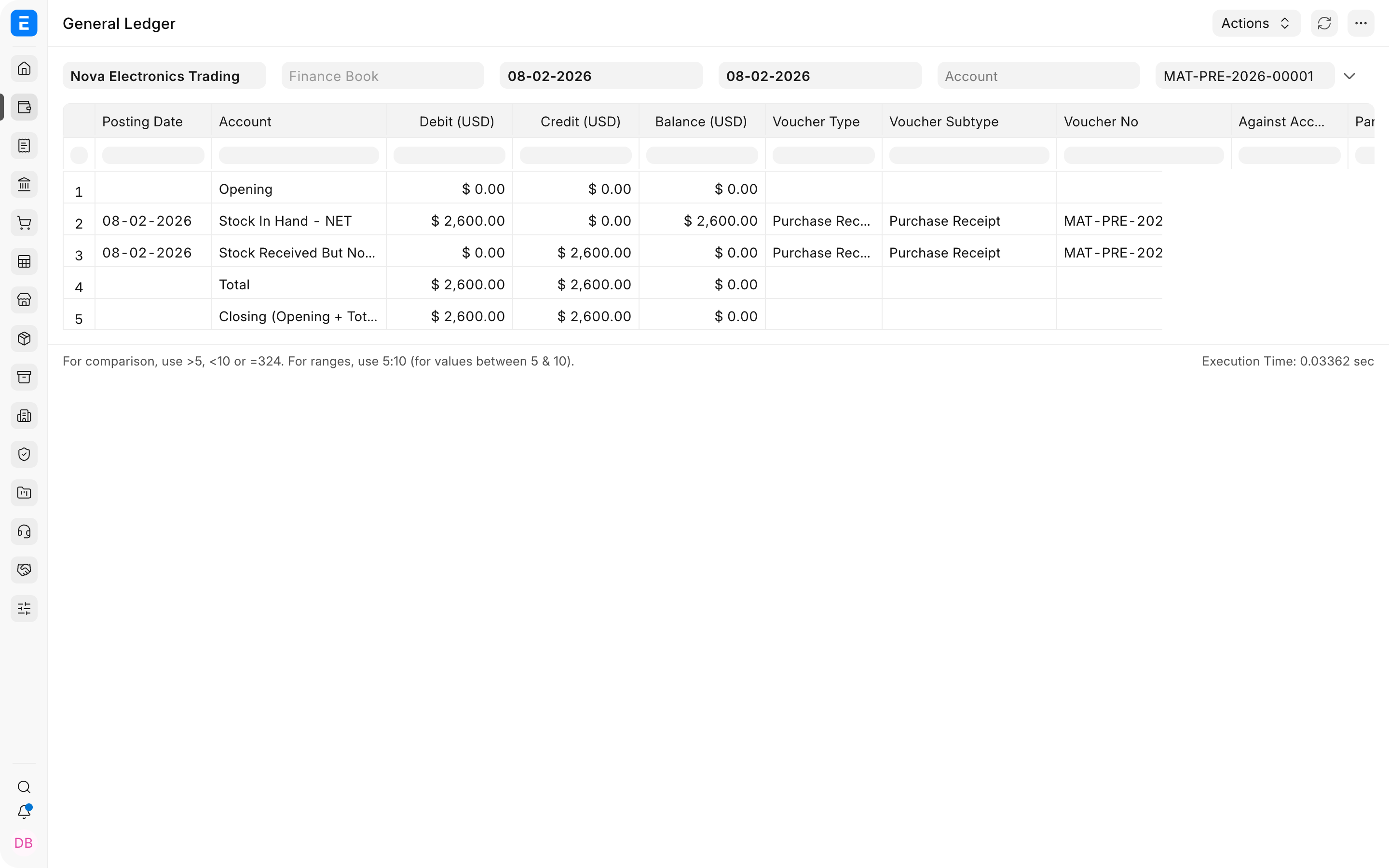
| Purchase Receipt for stock items | Debit Stock In Hand, credit Stock Received But Not Billed | The goods arrived, but the supplier's bill may not have. |
| Purchase Invoice against a Purchase Receipt | Debit Stock Received But Not Billed, credit the payable account | The temporary liability is cleared, and the billed amount becomes payable. |
| Purchase Invoice for a service | Debit the expense account, credit the payable account | The cost is recognized, and you owe the supplier. |
| Payment Entry of type Pay | Debit the payable account, credit Bank or Cash | You pay the supplier, and the liability goes down. |
Each event has two sides. For example, a payment to a supplier reduces what you owe, so ERPNext debits the payable account. The payment also reduces the bank balance, so ERPNext credits Bank.
About Stock Received But Not Billed
Stock Received But Not Billed is a temporary (clearing) liability account. The Purchase Receipt credits it, and the linked Purchase Invoice debits it. It lets you record the goods and the bill on different dates without losing the liability. When every receipt is billed at the same value, its balance is zero.
Example: buy stock items
A manufacturer buys five electronic units from a supplier at $520 each, a total of $2,600. The same flow applies to raw materials, components, consumables, or goods for resale.
Purchase Order. It records the supplier, rate, warehouse, and expected date. No ledger effect.
Purchase Receipt. The goods arrive:
Account Debit Credit Stock In Hand $2,600.00 Stock Received But Not Billed $2,600.00 Purchase Invoice against the receipt:
Account Debit Credit Stock Received But Not Billed $2,600.00 Creditors (payable) $2,600.00 The invoice does not debit Stock In Hand again, because the receipt already did. After both documents, Stock In Hand is debited, Creditors is credited, and Stock Received But Not Billed is back to zero.
Payment Entry for the invoice:
Account Debit Credit Creditors (payable) $2,600.00 Bank $2,600.00 The payment does not add stock or record the purchase again. It only settles the liability.
Example: buy a service
A services company buys ten support sessions from a supplier at $200 each, a total of $2,000. A non-stock service does not add stock, so the cycle usually goes from Purchase Order to Purchase Invoice to Payment Entry.
Purchase Order. It records the scope, quantity, rate, and expected date. No ledger effect.
Purchase Invoice. You accept the supplier's bill:
Account Debit Credit Professional Services Expense $2,000.00 Creditors (payable) $2,000.00 Choose an expense account that describes the service, for example Legal Expenses, Office Rent, or Professional Services.
Payment Entry. Debit Creditors $2,000.00, credit Bank $2,000.00, as for a stock purchase.
Compare the two flows
| Stage | Stock purchase | Service purchase |
|---|---|---|
| Purchase Order | No ledger effect | No ledger effect |
| Receipt | Debits Stock In Hand, credits Stock Received But Not Billed | Usually no receipt and no stock entry |
| Invoice | Debits Stock Received But Not Billed, credits the payable account | Debits the expense account, credits the payable account |
| Payment | Debits the payable account, credits Bank | Debits the payable account, credits Bank |
Variations
- Purchase Invoice with Update Stock. One invoice debits Stock In Hand and credits the payable account. It is useful for direct purchases, but removes the separate receipt document from the audit trail.
- Purchase Invoice without a Purchase Order. The invoice posts the same entries. You lose the purchase commitment, the approval trail, and the comparison of ordered, received, and billed quantities.
- Purchase tax. The payable account is credited for the full bill. The purchase is debited to its usual account, and recoverable input tax is debited to the tax account. Tax that you cannot recover can become part of the item cost or the expense, depending on the setup and local rules.
Why Stock Received But Not Billed has a balance
Look for Purchase Receipts that are not billed yet, Purchase Invoices that do not refer to the right receipt, differences in quantity or rate, returns, and cancellations with a past date. Use the receipt and invoice references to find the difference.