Create a debit note for a supplier return
A debit note reduces what you owe a supplier after you have submitted a Purchase Invoice. Use it when you return goods, or when the supplier agrees to reduce a bill. The original invoice stays as it is, so the audit trail shows what happened.
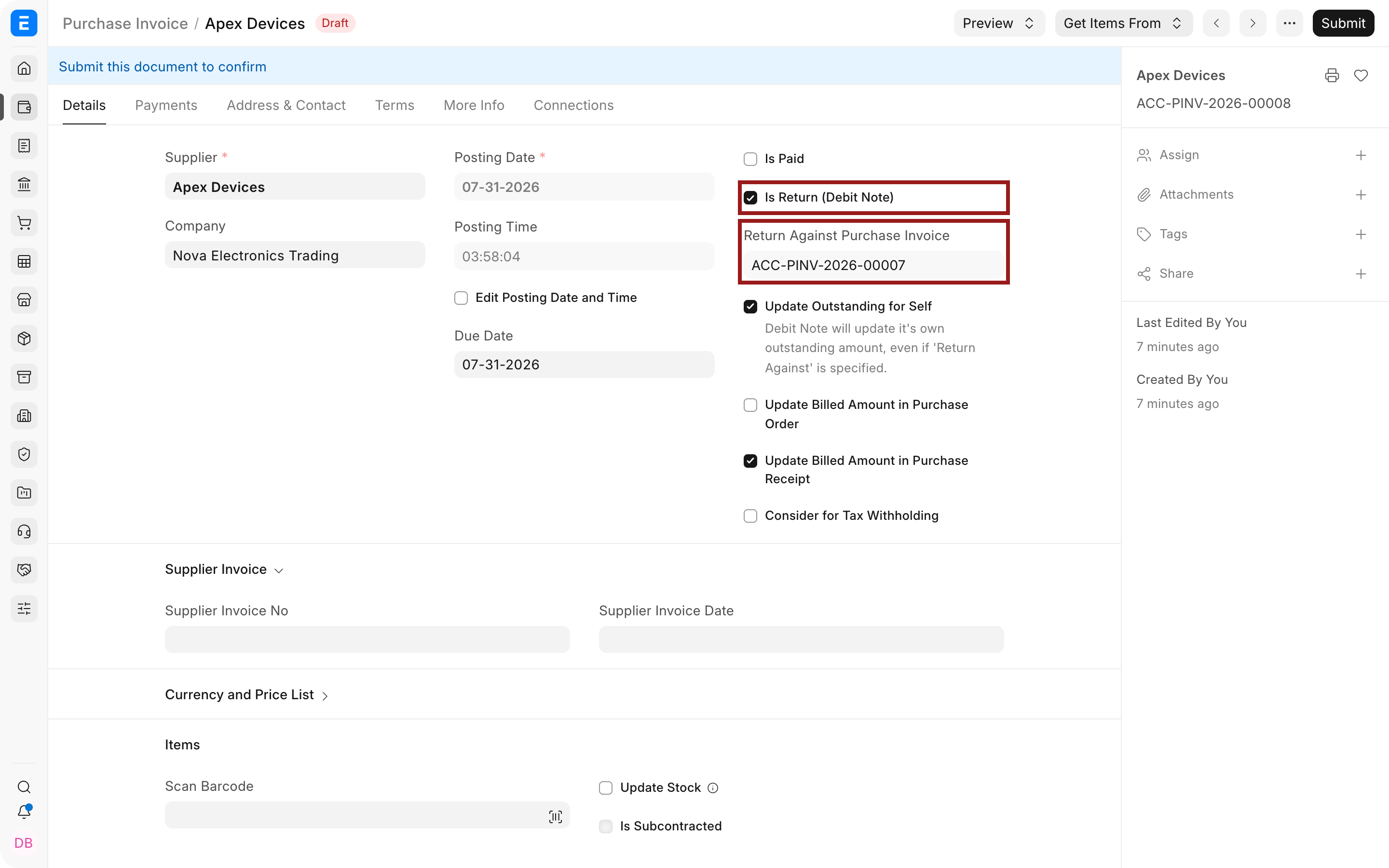
In ERPNext, a debit note is a Purchase Invoice with Is Return (Debit Note) selected. Its quantities and amounts are negative. It reverses the payable, the tax, and the expense, stock, or receipt-clearing value for the returned items.
To change only the price and keep the goods, see Create a debit note for a price adjustment.
Prerequisites
- The original Purchase Invoice is submitted.
- You know the items and quantities that you return, and the posting date of the return.
- You know whether the debit note must move stock, and whether a Purchase Receipt exists for the goods.
- You know whether the supplier has been paid.
Create the debit note
- Open the submitted Purchase Invoice.
- Select Create, and then select Return / Debit Note. ERPNext creates a new Purchase Invoice with Is Return (Debit Note) selected and Return Against Purchase Invoice set to the original invoice.
- Remove the rows of the items that you do not return.
- Enter each returned quantity as a negative number. For example, enter
-2to return two of ten units. - Select the edit icon at the end of the row, and check the quantity, the original rate, the Accepted Warehouse, the Expense Head, the Cost Center, and the references.
- If the debit note must move the goods out of stock, select Update Stock, and check the warehouse.
- Check Update Outstanding for Self (see the next section).
- Check the taxes and totals. The amounts are negative.
- Save and submit.
WARNING
Record each physical return once. If you return the goods with a Purchase Return against the Purchase Receipt, leave Update Stock clear on the debit note.
Choose where the credit goes
| Field | What it controls |
|---|---|
| Update Outstanding for Self | Selected by default. The debit note keeps its own outstanding amount, and the original invoice stays outstanding until you allocate the debit note to it. Clear it to reduce the outstanding amount of the original invoice directly. If the debit note is larger than what is outstanding on the original invoice, ERPNext selects it for you. |
| Update Billed Amount in Purchase Order | Reduces the billed amount of the linked Purchase Order. Clear by default. |
| Update Billed Amount in Purchase Receipt | Reduces the billed amount of the linked Purchase Receipt. Selected by default. |
Example of a partial return
An invoice has ten phones at $520 each. You return two damaged phones. Enter quantity -2 at rate $520. The debit note is -$1,040 before tax, and what you owe the supplier goes down by $1,040.
You can return some items, or part of a quantity. Keep the original rate, unless the debit note is a price adjustment. ERPNext does not let the total returned quantity exceed the invoiced quantity.
What the debit note updates
On submit, ERPNext reduces the supplier payable, and reverses the expense, asset, tax, or Stock Received But Not Billed values. With Update Stock selected, it also posts the stock leaving the warehouse.
- If the original invoice is unpaid, the debit note reduces what you must pay, after you allocate it or clear Update Outstanding for Self.
- If you have already paid the supplier, the debit note is a credit from the supplier. Allocate it to a later invoice with Payment Reconciliation, or record the supplier's refund with a Payment Entry.
Check the result
- Check the outstanding amount of the original invoice and of the debit note.
- Check the supplier balance in the Accounts Payable report.
- Select View, and then Accounting Ledger, to see the ledger entries.
- If Update Stock was selected, check the stock ledger.
Debit note status
| Status | Meaning |
|---|---|
| Draft | Not submitted. No ledger effect. |
| Return | The debit note is submitted. |
| Cancelled | The debit note was cancelled, and its ledger and stock entries were reversed. |
The original Purchase Invoice shows Debit Note Issued when a debit note brings its outstanding amount to zero.
Troubleshooting
"Qty must be negative in return document"
Enter the returned quantity as a negative number.
"Row # 1: Cannot return more than 8 for Item X"
Earlier debit notes already returned part of the quantity. Reduce the quantity to what is left.
The stock left the warehouse twice
Both a stock-updating debit note and a Purchase Return were posted for the same goods. Cancel one of them.
The original invoice is still outstanding
Update Outstanding for Self was selected, so the credit is on the debit note. Allocate the debit note to the invoice with Payment Reconciliation. Check the Payment Ledger entries of both documents.
Frequently asked questions
Can I create a debit note without an original invoice?
Yes. Create a Purchase Invoice and select Is Return (Debit Note) without Return Against Purchase Invoice. A linked debit note is better: ERPNext checks the returned quantities, and the audit trail is clearer.
Does every debit note move stock?
No. Stock moves only when Update Stock is selected. A price adjustment must not move stock.